
Views: 0 Author: Site Editor Publish Time: 2026-06-24 Origin: Site


Modern manufacturing demands strict sub-micron tolerances. Hard materials like solid carbide constantly test the limits of conventional equipment. Complex geometries require unparalleled kinematic control during machining. Shop floor managers currently face a pivotal shift. They are moving from legacy setups to fully automated 5-axis systems. You must carefully balance capital investments against daily production throughput. Evaluating these advanced upgrades directly determines your facility's future output quality. We introduce the CNC Tool Grinding Machine C818 as a dedicated solution for high-volume environments. It delivers distinct mechanical advantages for challenging flute grinding tasks. In this comprehensive guide, we objectively review its core capabilities and facility prerequisites. You will discover how automated optical measurement systems drastically reduce setup times. We also examine the structural rigidity required for flawless carbide handling. Learn whether this specialized CNC Tool Grinding Machine truly aligns with your specific production goals.
The C818 is engineered primarily as a 5-axis CNC tool grinding machine optimized for high-rigidity operations, particularly in manufacturing and resharpening carbide cutting tools.
Integration of onboard vision systems significantly reduces manual setup times and operator error, a critical factor for scaling 3C precision tool grinding.
While offering a highly competitive price-to-performance ratio compared to European or Japanese counterparts, buyers must account for operator training and facility climate control to realize stated precision metrics.
Evaluating this machine requires focusing on your specific geometry mix and requesting a vendor time-study to validate true cycle times.
Current tool production constantly faces severe operational bottlenecks. High scrap rates frequently stem from unchecked thermal expansion during intense grinding cycles. Inconsistent batch quality quickly ruins long-standing client trust. Excessive setup times for micro-tools heavily drain your shop productivity. Manual machinists continually struggle to maintain strict sub-micron tolerances over long shifts. Relying on human intervention introduces inevitable variations between tool batches. You simply cannot scale operations when operators manually index every single tool blank.
A successful upgrade requires verifiable repeatability across large, demanding batches. You must reduce reliance on highly specialized manual labor. Efficient kinematic systems inherently lower the operational energy consumed per tool. Modern facilities absolutely demand smart automation to keep spindles running continuously. The ultimate goal is achieving reliable, unattended precision throughout overnight shifts. Upgrading your shop floor means moving away from reactive machining. You want proactive, software-driven environments where predictable outcomes become the daily standard.
Transitioning to a dedicated precision tool grinding machine specifically resolves these workflow bottlenecks. The C818 architecture specifically targets long-term thermal stability and rapid setups. It eliminates the manual guesswork historically inherent in legacy equipment. You gain highly reliable output for complex end mills, step drills, and custom profiles. Shop owners notice an immediate improvement in first-part correctness.
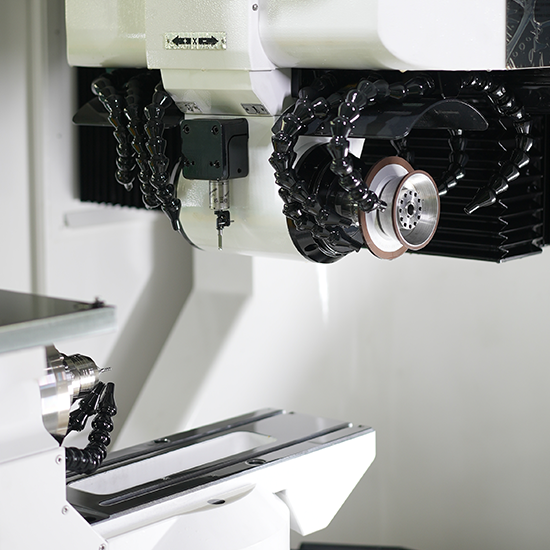
A robust foundation defines any high-performance 5-axis CNC tool grinding machine. The C818 utilizes a heavy-duty bed engineered exclusively for maximum rigidity. This immense mass effectively dampens vibration during aggressive carbide flute grinding. Operators experience far fewer chatter marks on complex tool geometries. Mechanical stability ensures your abrasive wheel wear remains predictable and perfectly even. You achieve vastly superior surface finishes directly off the grinding wheel. High bed rigidity also extends the usable lifespan of your expensive diamond wheels.
The integrated vision system fundamentally transforms how machinists approach daily setups. Automated wheel probing happens entirely inside the enclosed machine envelope. High-resolution optical sensors measure your tool blanks before actual grinding begins. This real-time data automatically compensates for any unexpected collet runout. You completely eliminate manual touch-offs and risky dial indicator readings. The system guarantees first-part correctness without continuous operator intervention. Less human contact means fewer opportunities for catastrophic alignment errors.
Spindle and drive performance directly dictate your overall cycle times. The C818 features advanced direct-drive technology on all critical rotational axes. High-torque spindles deliver consistent, unwavering power through dense carbide materials. Direct drives remove the mechanical backlash found in older belt-driven systems. We consistently see significantly reduced thermal distortion during extended grinding runs. Direct drives also provide faster acceleration profiles between complex toolpath movements.
Capability Area | Technology Integration | Primary Production Benefit | Impact on Workflow |
|---|---|---|---|
Kinematics | Heavy-duty cast bed structure | Dampens vibrations, improves surface finish | Reduces secondary polishing needs |
Measurement | Integrated onboard vision system | Zero manual touch-offs required | Cuts setup times by up to 80% |
Drive System | Direct-drive rotary axes | Eliminates mechanical backlash completely | Improves complex profile accuracy |
Thermal Control | Optimized spindle cooling circuits | Reduces thermal distortion risks | Maintains tolerances during long runs |
The Computer, Communication, and Consumer electronics sectors demand absolute dimensional perfection. Dedicated 3C precision tool grinding inherently involves incredibly tight manufacturing tolerances. Component manufacturers require perfectly reliable micro-end mills and intricate step drills. These tiny, fragile tools carve out complex smartphone housings and dense circuit boards. Highly customized profiles require exact dimensional accuracy every single production run. Even minor microscopic deviations cause catastrophic failures in downstream 3C component assembly.
Handling solid carbide introduces distinct, aggressive machining challenges. The C818 efficiently removes heavy stock material from incredibly dense carbide blanks. Excellent coolant delivery plays a massive role in this removal process. Targeted high-pressure jets actively prevent wheel loading and clear swarf instantly. You must utilize advanced filtration to extract microscopic carbide particles constantly. Clean coolant strictly prevents micro-cracking on newly ground tool edges. Superior filtration also protects the machine's linear guideways from abrasive damage.
Batch consistency effectively defines your global manufacturing reputation. The C818 heavily leverages software algorithms to maintain thermal stability continuously. This specific capability allows fully unattended, lights-out batch manufacturing. Operators can load a pallet of blanks and leave for the night. The machine automatically compensates for minor wheel wear as it progresses.
Common best practices for scaling 3C carbide grinding operations include:
Pre-warming the spindle to optimal operational temperatures before any cutting begins.
Monitoring exact coolant pressure to ensure consistent, aggressive wheel cleaning.
Programming frequent automated dressing cycles for sensitive micro-grain wheels.
Verifying raw blank runout strictly using the onboard vision system prior to engagement.
Scheduling regular calibration checks for all optical measurement cameras.
Upgrading to advanced multi-axis kinematics carries specific adoption risks. Operators accustomed to traditional 3-axis systems often face a steep learning curve. The shift requires mastering complex CAM programming and realistic 3D simulations. Machinists must quickly learn to trust automated probing over their familiar manual indicators. Management must invest heavily in initial software and operational training immediately. Ignoring this critical learning phase leads directly to expensive machine idle time.
Sub-micron precision equipment demands incredibly strict facility prerequisites. You simply cannot ignore the hidden environmental requirements of high-end machining. The shop floor requires rigorous ambient temperature control year-round. Fluctuations in room heat quickly cause measurable thermal drift in heavy metal castings. Advanced oil and coolant filtration systems remain absolutely essential for success. Clean cutting fluids ensure the machine consistently maintains its stated tolerances over time. Dedicated exhaust extraction systems must also handle the atomized coolant mist efficiently.
Calculating your long-term return goes far beyond evaluating the initial purchase. You must closely factor in significant improvements to overall tooling longevity. Decreased scrap rates immediately improve your daily manufacturing profit margins. The machine's intelligent power efficiency noticeably lowers ongoing electrical utility consumption. You should carefully evaluate how unattended overnight runs radically expand your overall production capacity. Focus entirely on daily cycle time reductions rather than solely reviewing capital outlays.
Evaluating complex machinery requires a very strict comparative lens. You must closely weigh the C818 against competing Tier-1 and Tier-2 market options. Focus carefully on software openness and overall network integration capabilities. Open architecture allows you to seamlessly use preferred third-party CAM systems. Support availability matters just as much as the machine's mechanical longevity. Reliable local technicians ensure your spindles stay turning during critical production shifts. Fast software support helps operators resolve programming errors without delaying client orders.
Never rely solely on glossy vendor specification sheets when making decisions. You must validate manufacturer claims using your own specific shop data. We strongly recommend providing complex DXF files directly to the machine vendor. Ask them to perform a custom test grind on your exact material. Analyze the resulting physical tool samples for surface finish and true runout. A live, recorded time-study reveals the true real-world capabilities of the kinematics.
Lock down your commercial procurement checklist long before signing anything.
Clarify all explicit warranty terms regarding the rotary axes and direct-drive spindles.
Confirm the exact geographical travel radius of local service technicians.
Establish the guaranteed lead times for critical spare parts delivery.
Review the manufacturer's preventative maintenance schedules and required consumable lists.
Request detailed documentation for post-processor integration and networking requirements.
The C818 perfectly serves specific, high-demand manufacturing environments across the globe. Mid-to-high volume tool manufacturers gain immense operational value from its advanced automation. Specialized 3C suppliers utilize its rigid precision to aggressively scale micro-tool production. Conversely, low-volume, general-purpose job shops might find the technology somewhat excessive. Standard 3-axis setups often suffice for basic, infrequent tool modifications. This advanced system thrives exactly where high repetition, speed, and tight tolerances intersect daily.
Take a definitive step to evaluate your current production readiness today. Download the detailed technical specification sheet to carefully review shop footprint requirements. Book a comprehensive software demo to properly assess the daily user interface. Submit a complex tool drawing directly to the vendor for a custom cycle-time analysis. Real-world testing will quickly prove exactly if this framework fits your floor.
A: The system fully supports open-architecture CAM software integration. Operators can easily utilize standard post-processors to translate complex 3D designs. Offline programming capabilities allow engineers to simulate toolpaths entirely away from the machine. This effectively prevents production downtime and catches collision errors before any grinding begins.
A: The vision system shifts setup from manual indicator alignment to optical automation. Lasers and cameras scan the blank inside the machine envelope. The software automatically compensates for collet runout and positional deviations. This eliminates human error and reduces setup times from minutes to mere seconds.
A: Daily tasks include checking coolant levels and cleaning optical sensor lenses. Weekly maintenance requires inspecting filtration media and gently wiping down trunnion seals. Annual service involves a comprehensive spindle geometry check and axis calibration. Following this routine ensures continuous sub-micron precision and extends bearing life significantly.
A: Yes, it strongly excels at both applications. The onboard probing system easily identifies worn tool geometries and existing flute indexing. It maps the wear patterns automatically to calculate the absolute optimal regrinding path. This dual utility maximizes machine uptime across different production departments.


