
Views: 0 Author: Site Editor Publish Time: 2026-06-22 Origin: Site


Automotive manufacturing evolves rapidly today. Electric vehicles and advanced combustion engines demand tighter engineering tolerances. These precision components require equally advanced machining strategies. Off-the-shelf tooling often falls short in this high-stakes manufacturing environment. Production teams struggle to reduce cycle times and consolidate operations effectively. Machining bottlenecks slow down output and severely strain production lines.
We will explore how dedicated equipment permanently changes this reality. Our evaluation examines the kinematics, operational footprint, and target applications of specific tool grinding solutions. You will learn how bringing custom tool manufacturing in-house boosts efficiency and mitigates supply chain risks. We specifically evaluate the CNC Tool Grinding Machine NZ-04S to see how it aligns with modern manufacturing goals. Production managers need objective data to make informed equipment decisions.
Capability Alignment: The NZ-04S utilizes a 4-axis linkage system, making it highly capable for standard and stepped automotive geometries, though it stops short of true 5-axis aerospace contouring.
Target Applications: Engineered specifically for the high-volume production and resharpening of automotive special cutters, including endmills, reamers, taps, and smilling cutters and drill bits.
Operational Footprint: Designed to balance rigorous precision thresholds with lower CapEx, offering a shorter ROI cycle for shops transitioning from manual grinding or legacy 3-axis setups.
Implementation Reality: Requires baseline CNC programming proficiency but minimizes manual setup variability through automated probing and standardized workholding.
Standard cutting tools rarely satisfy modern automotive production demands. Engineers design complex automotive components like engine blocks, steering knuckles, and EV battery trays. These parts feature intricate geometries and require exceptionally tight surface finishes. Standard off-the-shelf tools simply lack the optimized geometries required. Relying on standard catalogs forces programmers to use multiple tools for a single feature. This approach increases cycle times drastically. Tool changes consume valuable seconds. Machine spindles sit idle during these changeovers. Machining bottlenecks occur when cycle times exceed production targets. Throughput drops significantly. Manufacturers need a better approach to handle these specific geometric challenges.
Custom profile tools provide a direct solution to machining bottlenecks. Engineers design a single automotive special cutter to perform multiple operations simultaneously. A custom step drill can drill, chamfer, and counterbore in one continuous pass. Specialized forming cutters combine roughing and finishing profiles into one solid carbide shank. This consolidation eliminates unnecessary tool changes entirely. It ensures perfect concentricity between machined features. The demand for these tailored solutions grows exponentially. Tool rooms face immense pressure to supply these complex geometries rapidly. Delays in tooling directly halt assembly lines.
Carbide tools wear out predictably during heavy material removal. Outsourcing tool reconditioning introduces major risks. You must pack, ship, and wait for external vendors to process your tools. This creates significant supply chain vulnerabilities. Lead times often stretch into weeks. Extended delays force companies to hold massive backup tool inventories. Bringing a capable CNC Tool Grinding Machine in-house mitigates these risks effectively. You control your own tooling schedule. Worn cutters get sharpened and returned to the shop floor within hours. In-house control ensures absolute geometric consistency batch after batch.
Reduced Inventory Needs: Fast turnaround eliminates the need for large safety stocks.
Quality Control: Internal teams monitor precise edge prep and coating requirements.
Rapid Prototyping: Engineers can test new geometries immediately without waiting for external vendors.
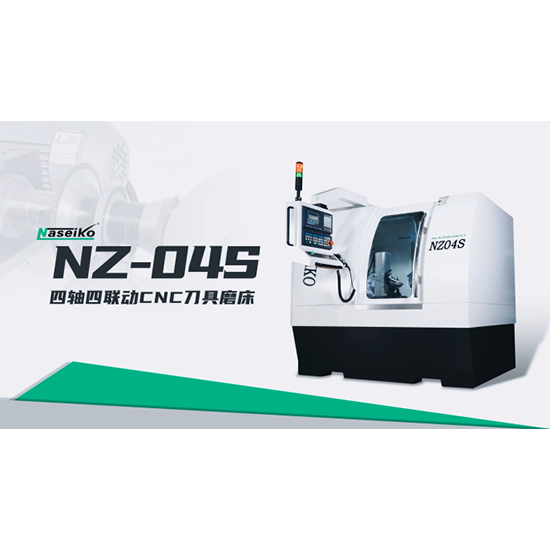
The core of any precision grinder lies in its kinematic design. This specific architecture utilizes a distinct four-axis linkage system. You typically find three linear axes (X, Y, Z) and one rotary axis (A or C). The linear axes handle precise positioning along the tool blank. The rotary axis controls the tool's rotation during fluting and relief grinding. This framework efficiently processes linear fluting paths. It excels at generating primary and secondary relief angles on the tool's cutting edge. A reliable 4-axis CNC tool grinding machine executes these movements simultaneously. Synchronized motion guarantees smooth transitions between different geometric features on the tool shank.
Machine rigidity dictates the final tool quality. Grinding tungsten carbide requires immense stability. We must evaluate the machine bed casting carefully. High-mass cast iron beds absorb resonant frequencies effectively. Spindle stability also plays a crucial role. Any spindle runout directly translates into edge chipping on the carbide blank. Micro-chipping ruins tool life before the cutter even hits the production floor. Robust vibration damping ensures a mirror-like surface finish. Smooth flutes evacuate chips better during high-speed machining. Standard ISO tolerances demand absolute structural integrity from the grinding machine base.
We must transparently define equipment boundaries. A five-axis machine adds a second rotary axis. You need five axes for complex ball-nose endmills or variable-helix geometries. Aerospace contouring demands full five-axis interpolation. However, automotive manufacturing relies heavily on step tools, straight flutes, and standard angles. A four-axis setup handles roughly 85% of these standard automotive tooling needs. It accomplishes this without the extreme complexity of a fifth axis. You achieve rigorous precision without overcomplicating the kinematic model. This distinction remains vital for realistic equipment evaluation.
Feature Segment | 4-Axis Architecture | 5-Axis Architecture |
|---|---|---|
Linear Fluting | Excellent | Excellent |
Step Drill Profiles | Highly Efficient | Capable (Overkill) |
Variable Helix Angles | Limited | Required |
Ball-Nose Contouring | Not Recommended | Industry Standard |
Maintenance Complexity | Moderate | High |
Automotive deep-hole drilling requires optimized geometries. Engine blocks feature numerous oil galleries and coolant channels. You cannot drill these successfully with standard point angles. Point thinning becomes absolutely critical. A thinned web reduces cutting pressure at the tool center. It prevents the drill from walking across the metal surface. Split-point geometries grab the material instantly upon contact. Web tapering adds strength to the drill shank while maintaining chip evacuation space. Operators use specialized grinding software to program these exact point features perfectly. Consistent web thickness prevents catastrophic tool failure inside deep engine bores.
High-speed milling relies on precise tool edge preparation. Machining aluminum engine components requires sharp rake angles. Cast iron machining demands stronger, reinforced edge lands. The grinding machine generates these precise rake angles effortlessly. It accurately controls land widths on high-performance smilling cutters and drill bits. Smooth transitions between the primary and secondary clearance angles reduce cutting friction. Lower friction means less heat generation during the milling process. Extended tool life directly results from perfectly ground clearance angles.
Best Practices for Milling Profiles:
Always verify wheel trueing before grinding primary relief angles.
Use fine-grit diamond wheels for final finishing passes on carbide.
Measure land widths optically before removing the tool from the collet.
Thread and bore finishing tools require exacting precision. Automotive steering components rely on perfectly round bores. Reamers dictate final bore size and surface finish. The machine maintains exact concentricity along the entire reamer body. Taps require perfectly spaced thread pitches. Any deviation in pitch ruins the tapped hole. Thread grinding demands highly synchronized rotary and linear motion. Operators rely on the machine's rigid spindle to hold these microscopic pitch tolerances. A well-ground tap cuts clean threads without galling the automotive component.
Equipment adoption depends heavily on usability. The control system dictates the learning curve for new operators. Modern interfaces utilize graphical, menu-driven software. Operators do not need to write raw G-code manually. The software handles complex mathematical interpolations behind the scenes. We evaluate its ability to manage standard tool libraries. A robust library allows users to select a standard endmill and modify parameters instantly. Custom automotive profiles require more input. The software must import DXF files accurately. It then translates these 2D profiles into exact grinding paths. Clear visual simulations prevent costly collisions before the wheel touches the blank.
Time is money in fast-paced tool rooms. Long setup times destroy profitability. Changeover efficiency determines overall equipment effectiveness. Wheel pack changes must be straightforward and repeatable. Operators use standardized wheel arbors to swap diamond wheels quickly. Collet swapping secures different tool blank diameters securely. Automated tool probing represents a major workflow upgrade. The machine physically touches the tool blank with a precision probe. It establishes exact tool length and orientation automatically. This eliminates manual touch-off errors. Rapid changeovers allow tool rooms to process small batches profitably.
Common Mistakes in Setup:
Skipping the wheel conditioning step after a wheel pack change.
Failing to clean the collet bore, resulting in tool runout.
Ignoring ambient temperature shifts which alter machine alignment.
Grinding carbide generates extreme localized heat. Proper environmental control prevents thermal damage. You must utilize dedicated grinding oil or high-quality synthetic coolant. Coolant filtration systems remove microscopic carbide swarf continuously. Dirty coolant acts like a slurry, destroying the tool's surface finish. Temperature control is equally critical. Chillers keep the grinding oil at a stable temperature. Thermal expansion in the machine casting distorts accuracy. Heavy material removal requires high-pressure coolant nozzles directed perfectly at the grinding zone. Preventing thermal micro-cracking on the carbide edge ensures reliable cutting performance.
Production managers face difficult equipment choices. Premium Tier-1 machines from Germany or Switzerland dominate the market. Brands like Walter and Schneeberger offer incredible capabilities. However, these premium machines carry massive capital requirements. We must analyze the cost-to-performance matrix objectively. You pay a heavy premium for proprietary software and absolute maximum axes interpolation. The NZ-04S targets the middle market effectively. It delivers the necessary rigidity and precision for automotive step tools. It sacrifices ultra-niche aerospace contouring for a significantly lower initial investment. This matrix helps evaluate real-world production value.
Over-engineering your tool room hurts profitability. Buying a high-end 5-axis machine to grind simple step drills wastes capital. We advocate for sensible downgrading. High-volume, repeatable automotive tools rarely require ultra-complex 5-axis interpolation. A reliable 4-axis system provides a much faster break-even point. Your initial capital outlay decreases substantially. You achieve identical cycle times on standard tool reconditioning. Return on investment shrinks from years to months. Sensible downgrading matches equipment capability directly to actual daily production requirements.
Objective evaluation requires structured criteria. Do not purchase equipment based solely on brand reputation. Analyze your specific production data first. Use the chart below to guide your evaluation process.
Evaluation Metric | Actionable Assessment Question |
|---|---|
Tool Volume Per Month | Does the volume justify dedicated internal equipment? |
Complexity of Geometries | Do tools feature standard angles or variable helices? |
Available Floor Space | Can the facility accommodate the machine and coolant chiller? |
Existing Operator Skill Level | Do operators understand basic CNC logic and tool geometry? |
Material Requirements | Are we grinding primarily HSS, Carbide, or Cermet? |
Automotive manufacturers cannot afford tooling bottlenecks in today's competitive landscape. Specialized cutters consolidate operations and slash cycle times dramatically. Bringing tool production and resharpening in-house secures your supply chain. We evaluated the CNC Tool Grinding Machine NZ-04S objectively. Our analysis proves it serves as a highly pragmatic, capable middle-market solution. It balances required precision with realistic capital investment. The four-axis architecture handles the vast majority of automotive step tools efficiently.
Your next step requires practical validation. Do not rely entirely on brochures. Request a specific cycle-time estimate for your most problematic tool. Arrange a test-grind using your own custom automotive cutter blanks. Evaluate the surface finish and geometric accuracy personally. Verify the interface software matches your team's technical proficiency. Practical testing ensures the equipment aligns perfectly with your specific manufacturing goals before you issue a final purchase order.
A: It has geometric limitations regarding variable helices. The 4-axis linkage processes straight flutes and standard uniform helices excellently. However, complex variable helix endmills require continuous 5-axis interpolation to adjust the wheel angle dynamically. For standard automotive step tools, this 4-axis setup remains highly efficient.
A: Setup times vary based on software utilization. Modifying an existing profile from the standard tool library takes roughly 10 to 15 minutes. Programming a completely custom geometry from scratch takes 30 to 45 minutes. Automated tool probing significantly reduces physical changeover times between different tool blanks.
A: Automation readiness depends on specific factory configurations. You can integrate robotic loading arms or standardized pallet systems. This integration facilitates unmanned, lights-out operation for large batches of identical cutters. Discuss robotic interface compatibility with the manufacturer before finalizing your equipment specification.
A: The machine handles Tungsten Carbide and High-Speed Steel (HSS) exceptionally well. You must pair the material with the correct abrasive. Use Diamond wheels exclusively for Tungsten Carbide to prevent wheel breakdown. Utilize CBN (Cubic Boron Nitride) wheels when grinding HSS blanks to prevent thermal damage.


